The Who, What, Where, When, Why and How of BDSM
BDSM as we know it is a term coined in the mid to late 20th century. The first reference we have is from archaeological artifacts and cuneiform tablets that came from Mesopotamia (circa 3000-2000 BCE) depicting ritual flagellation and erotic domination associated with fertility goddesses such as Inanna/Ishtar. These rituals often blended pain, submission, and ecstasy — spiritual and sexual elements that clearly predate modern kink.
Other references came from Ancient Greece and Rome where erotic art, particularly from Pompeii and Athens, shows scenes involving whips, bindings, and dominant/submissive power play. The poet Ovid even references flogging as erotic in Ars Amatoria (The Art of Love).
Then we have Medieval Europe (12th–17th centuries): Flagellation resurfaces in a religious context — self-punishment for sin — but also in private erotic forms. There are accounts of "flagellation brothels" in England and France by the 1600s where clients paid for erotic whipping.
As for documented history we start with 18th century:
The Marquis de Sade (1740–1814) and Leopold von Sacher-Masoch (1836–1895) are the literary namesakes of sadism and masochism. De Sade’s works like “Justine” and “The 120 Days of Sodom” describe consensual and non-consensual acts involving dominance and pain-the first time such dynamics are described in explicit, philosophical detail.
Then we have the Victorian era (1800’s):
There are surviving photographs, personal diaries, and advertisements from London and Paris referencing spanking, bondage, and corsetry as erotic play. “Disciplinary houses” and “birching parlors” were not uncommon. This period also marks the first commercial fetish communities, often centered on leather, latex, or uniform fetishes.
The 1800s saw a huge surge in what was then called “flagellation erotica.” These were underground books privately printed in London, Paris, and sometimes New York. They weren’t openly sold but circulated among collectors. Many featured themes we now recognize as BDSM — spanking, domination, bondage, and power exchange — all wrapped in Victorian language about “discipline,” “correction,” and “training.”
Writers like “Colonel Spanker,” “Theresa Berkley,” and “The English Governess” produced dozens of works that directly reference consensual erotic punishment, roleplay, and elaborate whipping devices.
Theresa Berkley & the Berkley Horse
One of the most famous historical dominatrices, Theresa Berkley, ran a high-end London “discipline house” in the early 19th century.
She invented a bondage apparatus called the Berkley Horse — a padded, adjustable frame used for flogging or birching. Her clientele included wealthy men and women, clergy, and public officials. Her shop had an inventory of whips, straps, restraints, leather cuffs, and even early versions of bondage furniture.
Parisian “Maisons de Correction” In Paris
Specialized brothels offered “correction” themes — bondage, caning, domination, roleplay, forced corsetry, and service dynamics. Records from police archives describe rooms equipped with:
• leather cuffs
• manacles
• padded benches
• suspension chains
• punishment stools
• whips and birches
These weren’t isolated’ several of these establishments operated openly under the guise of “discipline salons.”
Early Fetish Fashion & Corsetry
The 1800s also saw the first erotic use of what we’d now call fetish fashion. For some clients, the tight-lacing corset was a BDSM tool: a mix of restraint, aesthetic desire, and controlled power exchange.
There were also niche communities fixated on leather boots, riding gear, and military uniforms — all precursors to the leather scene that explodes later in the 20th century.
Private Clubs and Secret Societies
Some European aristocratic circles had private clubs devoted to flogging rituals and erotic roleplay. These were strict, rule-bound groups with formal scenarios, scripts, and roles that mirror modern BDSM dynamics. Documentation survives mainly in confiscated manuscripts and private diaries.
Early Photography Studios Specializing in Kink By the late 19th century, photography studios in both Paris and Berlin were quietly producing erotic photos of:
• bondage
• canings
• dominant women in corsets and boots
• submissive men kneeling
• leather straps and restraints
Many of these images were sold discreetly through coded catalogues.
Medical Writings Recognizing BDSM as Erotic
Strangely enough, some of the best historical documentation came from early sexologists like:
• Richard von Krafft-Ebing
• Heinrich Kaan
• Havelock Ellis
While they framed kink as “perversion,” they also preserved detailed descriptions of consensual BDSM practices from the people they interviewed — including bondage, flagellation, erotic dominance, humiliation play, and fetishism.
But BDSM the term was not known until the 20th century when Psychologist Richard von-Krafft, introduced the term in Psychopathia Sexualis. The term was built from the words Bondage, Discipline, Dominance, Submission, Sadism, and Masochism.
So, sit back and relax as I take you on a journey through my community and why we matter.
The Birth of 'BDSM' (1940s-1950s)
This was when Kinsey's research (1948, 1953) first documented these practices scientifically, and when underground communities started forming more visibly.
The 1940s – Why it’s crucial
The 40’s was where the foundation was laid for what was to become the modern BDSM community and movement. This is the era when gay men were coming home from WWII, where uniforms, strict structured discipline and leather gear was abundant.
The closets weren’t big enough. So began the growth of underground societies, private clubs. If you were not invited, you were not welcome. Homophobia was rampant then. You could literally lose everything from your friends, your job even your domicile.
It was also during this time that some zines and newsletters were starting to circulate. There were magazines, but they were extremely hard to get a hold of. These publications were laying the groundwork for future education and aesthetics.
Although male dominated the dynamics were starting to shift as secret networks allowed experimentation and skill-sharing.
In 1948 Alfred Kinsey’s first major publication Sexual Behavior in the Human Male was released. It was followed 5 years later with Sexual Behavior in the Human Female (1953). These publications fundamentally changed how the public and researchers viewed human sexuality.
These studies included statistical data on practices on everything from spanking, biting, restraint, and other forms of erotic power play. Kinsey didn’t label them “BDSM”, that acronym had not been used yet, but his data showed that a measurable portion of the American population engaged in or fantasized about such activities. Kinsey’s finding’s shocked me, and I imagine it will you as well.
Remember this was from the studies done in 1948 and 1953:
1) About 12% of women and 22% of men reported erotic arousal from being bitten.
2) Around 50% of men and women reported fantasies involving some element of domination or submission.
3) Between 5 and 10% of respondents had engaged in spanking, or bondage as part of sexual activity.
What made this revolutionary was not just the numbers, but Kinsey’s nonjudgemental presentation. He argued that such behaviors were within the normal spectrum of human sexuality, not deviance.
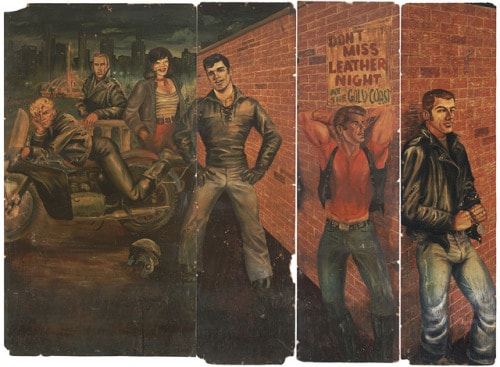
• About the Image
This painting is a mural by Dom Orejudos, who worked under the pseudonym Etienne. Created for the Gold Coast bar in Chicago — which Orejudos co-founded — the mural advertises “Leather Night” and stands as a visual tribute to one of the most iconic spaces in American leather history.
The Gold Coast is widely recognized as the first leather bar in the United States, opening in 1958 and setting the tone for decades of unapologetic masculinity, community, and kink-positive culture.
Orejudos was a towering figure in the gay community, known for his bold illustrations and writings that helped define and popularize the leather subculture from the 1960s through the 1980s.
His work wasn’t just erotic — it was cultural, political, and deeply personal.
Now we have the 50’s
The 1950s were a time of discretion and courage. Leather bars were beginning to appear, but never without consequences. Most stayed hidden — tucked behind unmarked doors, known only through invitation. Honestly, I imagine they were harder to get into than Mar-a-Lago today.
Many men returning from WWII military experience had experience with uniforms, leather jackets and discipline structure fitting right in what we now call the BDSM community. This influenced the look and rituals of the early leather culture: strict hierarchies (Master/slave, Daddy/boy), role playing, attention to detail/gear.
Art and visual culture were beginning to become more available. Small scale illustrations and leatherwork patterns circulated privately, and photographers captured leather fashion in private collections or zines. (Some underground newsletters — what we’d now call ‘zines’ — were beginning to circulate…)
he 40’s and 50’s was kind of like the early start to social networking. Word of mouth was the only way to get an invitation to any of the private functions, and that was basically the only way too get in.
People within the community started to socialize, where mentors taught art of bondage, they began to set protocols, how to make your own leather pieces, etc.
As we all know homosexuality and kink were outlawed in most countries and still is to this day unfortunately. This caused a massive underground to form, parties, group meetings the selling of erotic art. People were so afraid, advertisements were written in code, less the police found out.
The 50’s were busy!
· About the Image
· This painting is a mural by Dom Orejudos, who worked under the pseudonym Etienne. Created for the Gold Coast bar in Chicago — which Orejudos co-founded — the mural advertises “Leather Night” and stands as a visual tribute to one of the most iconic spaces in American leather history.
· The Gold Coast is widely recognized as the first leather bar in the United States, opening in 1958 and setting the tone for decades of unapologetic masculinity, community, and kink-positive culture.
· Orejudos was a towering figure in the LGBTQ community, known for his bold illustrations and writings that helped define and popularize the leather subculture from the 1960s through the 1980s. His work wasn’t just erotic — it was cultural, political, and deeply personal.
We had the Hoey Committee, a 1950 Senate Investigation. Their repot concluded gay people were “unsuitable” and “security risks.” Blackmail was cited as well though actual cases were rare.
Clarification: Although people referred to it as the “Hoey Report” it was factually called the “Employment of Homosexuals and Other Sex Perverts in Government.”
In 1953 Eisenhower signed Executive order 10450.
Adding “sexual perversion” as grounds for disqualification from federal employment. Thousands lost jobs. Estimates range from 5000 to 10000.
Clarification: EO 10450 never said “homosexual” explicitly — that was interpreted by agencies.
The Lavender Scare and the anti-communist Red Scare ran parallel to each other. With Senator Joseph McCarthy and his chief counsel Roy Cohn linking "Communists and queers" as threats to the nation's security.
Around 1950 the Mattachine Society was founded in Las Angles by Harry Hay and other activists. It was a major homophile organization, structured somewhat secretly. According to Britannica, they saw themselves as an oppressed minority and used a cell structure. Gay and leather/kink networks often functioned like cells, small semi-secret, to protect others in the organization from police harassment and social repercussions.
Daughters of Bilitis founded in 1955 in San Francisco by Del Martin, Phyllis Lyon and other lesbian couples. It began as a social club for “Lesbians,” who wanted a safe place from the hostile public.
Legal victories from the 1950’s were impressive to say the least concerning the publics view on homosexuality. There was:
Stoumen v. Reilly (1951). On August 28, 1951 The California Supreme Court ruled that just having homosexual patrons is not enough to revoke a bar’s liquor license. According to the opinion, there needed to be evidence of illegal or immoral acts, not just patrons’ sexual orientation.
We then get to dale Jennings Trial in 1952. According to sources he was arrested in 1952 apparently for “Solicitation “ after hitting on a police officer. Apparently the jury dead locked for his defence but there is no proof as there are no court documents are being elusive.
And One, Inc. v. Olesen was about pro-homosexual writing. This was a major case as The Supreme Court held that pro-homosexual writing is not inherently obscene.
This was indeed a First Amendment win for the gay community.
And we can’t forget: The Cooper’s Donut Riot, yes you read that correctly. Apparently in May of 1959 a donut shop in downtown Los Angeles called Coope’s Donuts was the site for what some say is the first known act of resistance in the Gay Community even though it lacks documentation.
According to first person accounts police cam in and demanded ID from 2 Drag Queens, 2 Hustlers and a guy cruising. When the police tried to force them all into a police car (Very crowded,) people inside started to push back according to John Rechy (City of Nights) (*who said he was there).
Other patrons joined in and were throwing everything they could at the police, donuts, coffee cups, anything they could get their hands on.
And now we are into something documented, Evelyn Hooker’s Research (1956).
Psychologist Evelyn Hooker presented a research paper “The Adjustment of the Male Overt Homosexual” to the American Psychological Association convention in Chicago.
Using 60 men 30 homosexuals and 30 straight, she gave them the Rorschach Inkblot Test, Thematic Apperception Test (TAT) and the Make-A-Picture-Story (MAPS) Test. The results were then presented to a panel of independent, expert clinicians who were unaware of any person’s inclinations to homosexuality.
They were asked 2 things, rate the men’s mental health and attempt to distinguish the homosexuals. The experts could not distinguish between the homosexuals and the straight’s providing proof that there was no mental deviation from the 2 groups.
This paper became the cornerstone of the gay rights movement and eventually led to the removal from it’s Diagnostic and Statistical Manual of Mental Disorders (DSM) in 1973.
Now into the 60’s and 70’s
This is where things become more visible, more organised, and increasingly visible to researchers and community historians.
Key themes & events
Bars & venues were starting to show up in the open. The neighbourhood of South of Market (SoMa) in San Francisco becomes a focal point for leather/kink culture. For example: the bar “The Tool Box” opened in 1962 at 4th & Harrison, with a mural by Chuck Arnett; the nearby leather bars “The Stud” and “Febe’s” opened circa 1966–68.
As the Leather Culture grew shops that catered to fetish gear started to open. “The Leathermaker” opened on Melrose, LA in 1960.
Media & print: Magazines and contact‐ads appear, enabling people with fetish interests to connect. As noted: by the 1960s magazines included “contact ads and advertisements for BDSM equipment and fetish clothing” and “gay motorcycle clubs … helped those who find one another” in these years. Taylor & Francis
Leather identity & rituals: The leather subculture began to develop ‘codes’—visual signals, uniform elements, role labels (e.g., “Daddy”, “boy”, “Master/Slave”) especially in gay leather communities. Fetish Men San Diego
Intersection with gay rights: While not always explicitly kink‐focused, the broader sexual liberation and gay rights movements of the 1960s contributed to making gay/kink spaces more visible and somewhat more socially viable.
- International spread: While much documented in the U.S., similar biker/leather/kink clubs also emerged in London, Amsterdam, Berlin in the 1960s.
Who Cynthia Slater Was
Founder of Society of Janus (1974)
• A pioneering BDSM organization in San Francisco.
• Created as a pansexual group to teach, support, and normalize BDSM practices.
• Still active today, it was one of the first groups to openly provide BDSM education.
Community Builder
• Slater worked to bring women into the leather/BDSM scene, which had been dominated by gay men.
• She hosted the first all-women’s play party at The Catacombs, a legendary San Francisco dungeon.
• Activism in the AIDS Crisis
• Diagnosed HIV+ in 1985, AIDS in 1987.
• Became a strong advocate for women with HIV/AIDS, pushing for visibility in a crisis often framed as affecting only men.
• Worked with the Shanti Project, supporting people living with AIDS.
Legacy
• Remembered as both an artist and activist.
• Helped shape BDSM culture into something more open, educational, and community driven.
• Her death in 1989 marked the loss of a key figure in both kink and AIDS activism.
Key Takeaway
In the 1970s, Cynthia Slater and the Society of Janus were central to BDSM education and community building. Far from being a “cult,” it was a pioneering support and teaching organization that helped legitimize BDSM practices and foster inclusivity. Slater’s activism during the AIDS crisis further cemented her legacy as a bridge-builder between kink, queer, and health communities.
Which leads us into the 2000’s and beyond.
The term BDSM itself was not coined until around the 1960s–70s, when the early gay leather and fetish communities (especially post–World War II) began organizing formally.
- The postwar gay leather movement emerged from military culture, motorcycle clubs, and underground queer safe spaces.
- The word “BDSM” merges B/D (bondage & discipline), D/S (dominance & submission), and S/M (sadomasochism) — acknowledging overlapping but distinct aspects of the kink world.
· Next up we’ll have the1980’s to present.
· Then in Part 5:
· BDSM: The Discipline, The Kinks
· Chapter 5 is going to dive into the various kinks (At least the ones I am aware of) or involved myself.
· This unfortunately will render that part of my blog, NSFW. Thus, an adult only rating.
· I would love to list all the reference material used but it would take over a page and a half. All of it can be searched and verified as much as possible by any AI and I used 5 to check the authenticity of what I wrote.
· © 2025 Sean Hogan and Silver Triangle Leatherworks